Dragons are mighty, intelligent beasts that master the sky. They are ancient in origins and mind. As wardens of the natural world, they command the very forces they protect. Their bodies glitter like gemstones, even beneath the cover of night.
Draccus
|
Origins Current Nation |
| Language | Draconic |
| Lifespan | Extremely long |
| Avg. Height | 250 cm |
Biology
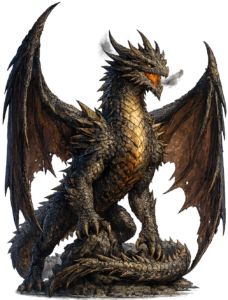
Dragons are quadrupedal sapient creatures with wings made of translucent membranes. Their serpentine bodies are covered in thick, diamond-shaped scales that glitter in dim light. The color variety is enormous. Dragons are armed with teeth, talons, horns and natural affinity for their associated element.
Natural Abilities
Dragons are blessed with a variety of natural abilities. While all dragons share a handful of abilities, each subtype has their own sets of additional features unique to them.
Natural Weapons
Every dragon is armed with long, sharp teeth and talons. Both are used for hunting but are also suited to melee combat. The dragons wings can be used to strike persons at its sides. The force the wings produce is less destructive than the teeth or talons, but it can help push away assailants. Finally, the lithe tail can be used to swipe at enemies; either those stationed behind the dragon or those it wants to topple. The tail has the advantage of having spikes along it that can harm assailants. However, the precision of the tail is reduced because it falls outside of the periphery of the dragon.
Defensive Scales
Dragons are clad in brilliant scales. Even the darkest of dragons have luster. These thick, diamond-shaped scales cover their bodies from snout to tail. The scales deflect blows from weapons by being hard and sturdy. Additionally, there is an innate magic imbued into the scales of dragons. This magic makes it nearly impossible to penetrate the scales with blunt, hard or sharp weapons. These defenses make dragons extremely difficult to defeat.
Moreover, the spines of dragons are covered in a row of spikes, These spikes make it difficult for something or someone to jump the dragon from behind, as this risks the attacker impaling itself on these spikes.
Alternate Form
Every dragon has the innate ability to shapeshift. Young dragons are thought to consciously choose what shape they wish to possess, besides their dragon form. Once chosen and transformed, the dragon can no longer choose a secondary form. Every dragon has only two forms and cannot freely shapeshift into something other than dragon or chosen second form. The secondary forms the dragons have are common beats.
Family Structures
Dragons sometimes choose mates from among their same subtype but that isn’t strictly the case. Dragons are known to be serial monogamists; having a single mate for an extended time. If the mate dies or they part, the dragons may choose another exclusive relationship with another.
Though dragons don’t have marriage, they have a special ritual exclusive to them that solidifies their relationship. The ritual is performed at the base of the Dragon Tree and is often witnessed by close friends of the dragons. The dragons declare their affection and imbue the tree with their Source; combining their two energies into one. This inspires the Tree to grow additional fruits, infused with these two energies. These fruits develop into dragon eggs as they grow on the tree. The ritual announces the relationship between the two dragons, as well as helps the species reproduce.
Some dragon couples choose to wait by the tree until their eggs are ready while others visit occasionally. Some never return at all. When their eggs have fully grown, the dragon parents sometimes choose to care for them on their own, instead of offering them to the care of the guardians of the Dragon Tree. How the dragon parents identify which eggs are related to them is unknown. Orphaned eggs are sometimes claimed by couples without eggs or couples who have not made their relationship official.
Life Stages
Dragons are a species who choose to raise their young, rather than abandoning them to fate’s design. Moreover, dragons appoint caretakers and guardians; ensuring the safety, adequate care and a thorough education of the hatchlings.

Egg
All dragons start their existence as eggs, protected by the guardians of the Dragon Tree. The color and pattern of the egg reflects the scale colors the dragons will have upon hatching.
The eggs grow on the branches of the Dragon Tree; steadily increasing in size. Once of an adequate size and level of development, the eggs will drop to the ground. The Tree’s guardians will collect them into a safe location where they are tended to until hatching. Alternatively, the eggs parents will gather them and keep tend to them until they hatch.
Hatchling
0 – 6 months
This stage encompasses the first stage of a dragon’s life. They are born with a full set of scales, although they are small. Their wings, spikes, talons and teeth are also fully grown.
Once hatched, the dragon is known as a hatchling. At this stage, the young dragons are still dependent on others for resources like food. As they move through this stage, the parents or guardians watching over them will care for them as well as educate them.
Some hatchlings will instinctively begin to channel the element of their subtype. Others will not and will be aided by the parents or guardians to discover and channel their element. In addition, the dragons are taught to fly at the end of this life stage.
Adolescent
6 months – 2 years
At this stage, the dragon grows into their full size; some growing faster than others. They reach their full size around two years of age. Their wings grow in size, allowing them to accelerate their flight. The size of their scales grow to accommodate their increased statures.
During this stage, young dragons travel with their parents to learn more about the world. Young dragons without parents are under the tutelage of a mentor. This mentor adheres to a position or lifestyle the young dragon aspires to. Sometimes the mentor belongs to the same subtype as the young dragon, but this is not strictly the case. Besides the niche knowledge and skills of the parents or mentor, the dragon learns competencies to safely set out on their own. Many do at the end of this stage.
Adult
2 years+
Once a dragon reaches adulthood, they become full members of society. They may participate in dragon politics, take up important positions in society or take lands of their own. At this stage, the lives of various dragons become highly diverse.
Subtypes
Dragons come in 16 subtypes. Each has their own distinct colors, abilities and preferences. The subtype of a dragon is independent of their parents. Though both dragons and dryads have attempted to pinpoint genetic consequences, they have so far failed to identify a pattern.
Some subtypes of dragons appear more frequently than others. Since all dragons hail from the same birthplace, this cannot be attributed to environment.
Society
Dragons don’t build communities in the same way other sapient races do. While they do have a collective home and origin with the Irvin Tree in the Klerthinwinna Mountains, they do not recreate such situations elsewhere.
Instead, every dragon finds a landscape that appeals to them; often associated with their element. Many of them choose a solitary existence. Others group together with friends and family or a mate and offspring. Some dragon subtypes prefer one style of living but it remains to be dependent on their personalities.
Even though plenty of dragons live in distant reaches and might not communicate with others, they do all agree on one thing; the monarchy. Dragons have always upheld a king or queen. This sovereign does not make laws or decisions for the dragon realm as a whole. Instead, they function as a central point of government. Their title is often ignored until surrounding situations demand someone to lead; such as in times of famine, war or other great disputes.
When a king or queen perishes, another is elected from among well-respected dragons. They are chosen through a democratic vote. Every adult dragon is allowed to voice their preferences, regardless of age. Equally, any dragon of adult age may nominate themselves for the crown. However, most elected kings and queens were older dragons who accomplished many good deeds for their kin.
When mated to the monarch, the mate is considered the royal consort. They are not automatically elected when the original monarch perishes. However, their proximity to government has made them adept rules. This has resulted in their election on various occasions. Offspring of great rules aren’t automatically elected either, but they enjoy equal advantages to the consorts.
Death remains the most common reason a dragon monarch needs to be replaced. A handful have abdicated, however. Their reasons varied; old age, illness, exhaustion or feeling unfit. An equal amount have been deposed; a process performed through voting.
Because of this solid system, many dragons maintain their faith in the system.
Soulbonds
Since the end of the War of Blood and Bones (1448 MC – 1730 MC), dragons have gained the ability to tie their souls to a human, a dryad or an elf. This connection is called a Soulbond. The bond is of the dragon’s choosing and once established, becomes unbreakable. Upon the death of either partner, the remaining individual cannot bond again. Scholars have pointed to the alteration of their soul as preventing them from forging a second bond.
Origin of the Soulbonds
Once the War of Blood and Bones ceased (1730 MC), thanks to the friendship formed between Siphonix and Ellowin, the dragons and elves agreed to manifest peace. To reinforce their alliance, they agreed to bind the treaty to the land itself, instead of prescribing it onto paper. Utilizing the knowledge of the empyrean dragons, the strength of dragons in general and the spellcasting abilities of elves, the treaty was forged into the earth, the wind and the world at large.
The immediate result was the bonding of three dragons in attendance to two elves and one dryad. They were the first of the Soulbonds and established the Scaleguard (1732 MC); the organization formed to maintain peace between the various peoples. Furthermore, newly hatched dragons sometimes felt compelled to form the bond with a humanoid in their vicinity. Some still preferred to live wild and free but the races of dragons, elves and dryads had forever changed.
Once the Valtaer Empire stabilized under the rule of Laudius Valtaer (2117 MC), the first humans bonded with hatchling dragons. Their addition to the Scaleguard reinforced the peace between all four involved races.
Bonding Ceremony
When the Scaleguard maintained their power and control throughout the continent, the Bonding Ceremony was an annual event where Guardians of the Dragon Tree escorted young dragons to a special location. At this location, humans, dryads and elves would meet the dragons and present themselves to the young dragons. The entire Ceremony was overseen by members of the Scaleguard to ensure peace and safety.
Candidates seeking a dragon bond would present gifts and offerings to the dragons; gemstones, precious meats, flowers and stranger, exotic items. Once the offerings were received, the Guardians would present the young dragons; maintaining careful watch over them for safety.
Young dragons could choose a Soulbond from among the candidates, if they so wished. If they chose someone, their bond would be formed through the magic imbued into the world. They would then be presented to the gathered group as a new team and asked to formally join the Scaleguard. Rejecting such an offer was considered bad form and has only been recorded twice in history.
Young dragons who refused to bond could choose to return the next year or to venture out on their own once they reached adulthood.
Effects of the Bond
The bond formed between dragon and Soulbond affects both parties, though to different degrees.
| Dragon | Both | Soulbond |
| ♦ Comprehension of the Soulbond’s native language | ♦ Telepathic communication
♦ Awareness of other’s emotional and physical state ♦ Sharing of Source |
♦ Dragon Gift(s)
♦ Access to the dragon’s Source |
With the passing of time and the strengthening of the bond, both dragon and Soulbond’s abilities grow. Their telepathy becomes faster and more nuanced without losing understanding. A certain anticipation about the other’s state or actions grows. This synergy makes the team more powerful over time and more so than if they acted individually.
An unofficial ability offered to both is an increase in adrenaline when protecting one another. Due to the love that grows through the bond, both parties are dedicated to one another’s safety and can reach beyond their regular abilities to achieve it. The downside of this is that the death of the other member of the team can cause untold grief and even madness.
Dragon Gifts
Bonded dragons offer gifts to their Soulbonds. The gifts the dragon manifests are seemingly random. Neither scholars nor dragons themselves have been able to determine a system that reliable predicts the gifts manifested. The gifts are considered magical. Gifts are maintained while bonded, despite physical distance. However, upon the death of one’s dragon, the gifts are relinquished.
| 👁️ | Acuity | 🔮 | Prescience |
| Acuity is the enhanced ability to see, hear, smell and in other ways perceive what others might not. The counterpoint is that stimulus becomes more easily overwhelming. | The prescience ability manifests to different degrees. It allows the user to perceive the near future; sometimes spanning only a few seconds. | ||
| ✨ | Sorcery | 💭 | Telepathy |
| Sorcery is the ability to cast spells. The ability is limited by one’s knowledge of the names of various elements, one’s will and the allocation of Source. | Telepathy is the ability to contact another creature with one’s mind. Communication can be done with words, memories and unspoken sensations. | ||
| 💪 | Vigor | 🍃 | Wildsong |
| Vigor manifests in the physical body. The person gifted with Vigor has enhanced speed, strength, stamina and can endure longer without food, water or rest. | Wildsong reflects the echoes of the past; showing its user a faded image or experience of what once was. It accesses the memories stored in the land itself and the creature within it. |